
Monterey Park Wood Flooring has handled water damaged hardwood floor repair in Monterey Park, CA for more than 20 years, serving surrounding cities including South San Gabriel, East Los Angeles, Alhambra, Montebello and Rosemead. When a supply line bursts, a dishwasher leaks or a slab leak pushes water up through the floor, we measure how far the moisture has spread, document it for your insurance claim, and repair the floor so it matches rather than looks patched.
Water damage is a race against time and a test of patience at once. The first hours decide how much wood can be saved, but rushing the repair before the boards and subfloor have dried is how a cupped floor turns into a crowned one a month later. We guide you through both halves: what to do immediately, and when the floor is truly ready to be repaired, sanded or replaced.
We work alongside plumbers, restoration companies and insurance adjusters. Our reports use photographs, moisture meter readings and room-by-room drawings, and our repair scopes are written in terms an adjuster can check, describing matching board and finish rather than a patch.
Residential and Commercial Water Damage
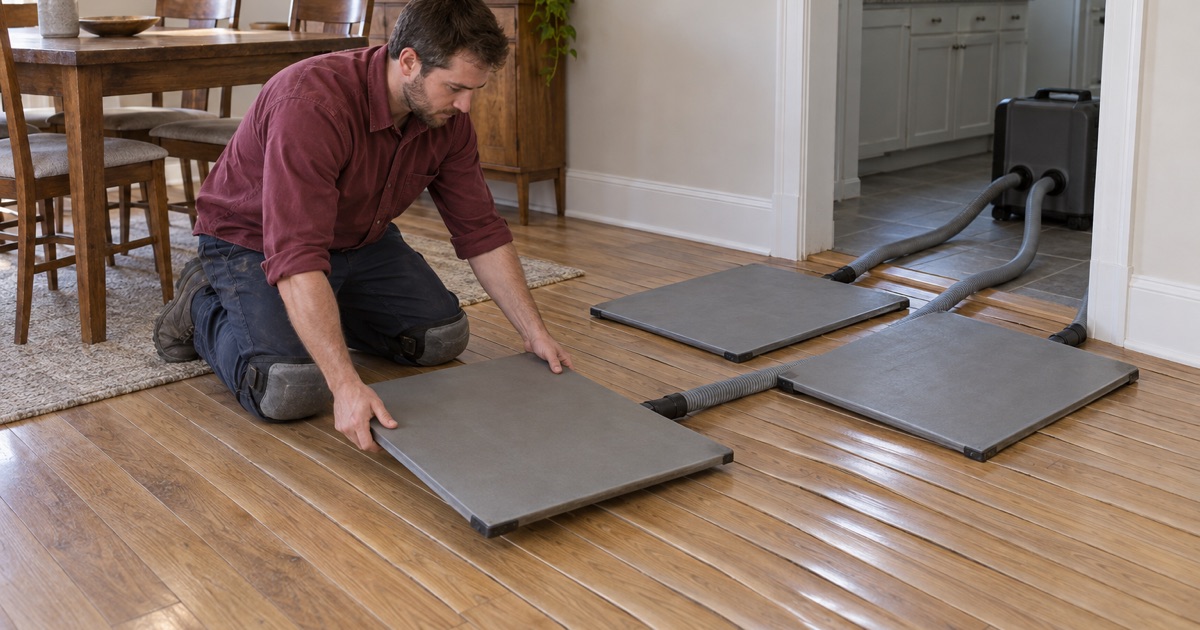
Burst Supply Lines and Appliance Leaks at Home
The most common water losses we see start in kitchens, laundry rooms and bathrooms: a supply line under a sink, a refrigerator’s ice maker line, a failed dishwasher hose or a washing machine connection. Water spreads under cabinets and along the floor’s tongue and groove joints, often traveling far beyond the visible puddle.
We map the wet area with a moisture meter across the whole room and into adjoining rooms, because a hardwood floor wicks water sideways through its joints. That map, not the size of the stain, decides which boards come out and which can be dried in place.
Slab Leaks Under Hardwood
A leak in a pipe running through or beneath a concrete slab can push moisture up into a glue-down or floating floor for weeks before anyone sees it. Signs include a warm spot on the floor, cupping in one area, or boards lifting near a wall where a line runs.
Once a plumber has located and repaired the leak, we test the slab and the flooring to see how much moisture remains. Engineered floors over a slab often need the affected area removed so the concrete can dry, followed by new planks set with a moisture-control adhesive suited to the conditions.
Offices, Shops and Restaurants
Commercial water losses often come from a roof leak, a sprinkler line, an ice machine or a restroom overflow. The pressure is to reopen quickly, but a floor rushed back into service while wet can fail again within weeks.
We work around business hours, section off the affected area, and plan drying and repair so the rest of the floor can stay in use. Our documentation is prepared for commercial property claims, with readings, photos and an itemized scope.
Drying and Assessing a Wet Hardwood Floor
The First Two Days After a Leak
Stop the water at the source, then remove rugs, furniture and anything absorbent from the wet floor. Wipe up standing water, open windows if the air outside is dry, and run fans and a dehumidifier if you have them. Photograph everything before it is moved, and call your insurer to report the loss.
Avoid heating the room aggressively or sanding and sealing anything. Fast, uneven drying can crack boards, and sealing a wet floor traps moisture inside it. Our role at this stage is to measure the floor and advise whether professional drying equipment is needed.
Moisture Mapping Above and Below the Floor
We take readings in the boards, in the subfloor and in the crawl space or slab, and compare them with readings from a dry area of the same house. On a raised foundation we check whether water has reached the joists and the cripple wall, and whether insulation or soil beneath needs attention.
Those readings are repeated over the drying period and recorded with dates. They show you, the restorer and the adjuster when the floor has returned to normal, and they are what we use to decide the timing of any repair.
Deciding What Can Be Saved
Cupped boards often flatten substantially once dry and may only need sanding and refinishing. Buckled boards that have lifted off the subfloor, boards with black water stains where moisture reacted with the wood’s tannins, and areas with mold or delaminated subfloor usually need to be replaced.
We explain each area’s condition in writing and show you why a board is being replaced or kept. Where the floor is engineered hardwood, we also check whether the wear layer has separated from its core, which rules out sanding.
Insurance Claims and Matching Your Floor
Documentation Your Adjuster Can Use
A strong claim file shows where the water went, how wet the floor got, and how it dried. We provide dated photographs, moisture readings on a floor plan, a description of the flooring species, width and finish, and an itemized repair scope.
We write the scope as the work the floor actually needs, including subfloor repairs, board replacement, sanding and finishing, trim, and moving furniture. That clarity helps prevent the back-and-forth that slows many flooring claims.
Matching and a Reasonably Uniform Appearance
California’s fair claims regulations call for replacement items of like kind and quality and a reasonably uniform appearance. For a hardwood floor that runs continuously through several rooms, replacing only the wet boards and refinishing only that area can leave a visible line where old finish meets new.
We document how the floor flows between rooms and whether a partial repair can blend, and we put that in writing. Your adjuster makes the coverage decision, but it is made on clear evidence rather than guesswork.
Condo and Shared-Wall Water Losses
In condos and townhomes, water often comes from a neighboring unit or a common pipe, and responsibility can be split between owners, insurers and the association. We document each affected room separately with dated readings, so every party is working from the same record.
We also confirm the association’s flooring rules before replacing anything, including acoustic underlayment requirements, so the repaired floor meets the same rules as the original. Product sheets for the replacement flooring and underlayment are supplied for the association’s file.
Our Step-by-Step Water Damage Floor Repair Process
Step 1: Emergency Assessment
We measure the extent of the moisture, photograph the floor, and advise on immediate drying steps. If professional drying equipment is needed, we coordinate with a restoration company.
Step 2: Drying and Monitoring
We take repeated moisture readings in the boards and subfloor until they return close to normal levels for the house. Each reading is dated and recorded for the claim.
Step 3: Scope and Documentation
We prepare an itemized repair scope with photos, moisture maps and matching notes for your insurer. You and your adjuster review it before work begins.
Step 4: Structural and Board Repairs
Damaged subfloor, joists and boards are replaced, and new boards are woven into the existing floor. Matching species, width and cut are sourced before this step starts.
Step 5: Sanding and Finishing to Match
The repaired area, or the whole continuous floor where needed, is sanded, stained and finished to match. We finish with products compliant in the South Coast air district and leave you a written cure schedule.
- 20+ Years on Wood Floors
- Itemized Written Quotes
- Lead-Safe Checks on Pre-1978 Homes