
Monterey Park Wood Flooring has spent more than 20 years on hardwood floor repair in Monterey Park, CA, serving surrounding cities including South San Gabriel, East Los Angeles, Alhambra, Montebello and Rosemead. We replace damaged boards, quiet squeaks, reattach loose and hollow areas, and repair termite and water damage, then finish the repair so it blends into the floor you already have. Most floors that look ruined are a repair, not a replacement.
A good repair starts with the cause. A stained board next to a dishwasher is a plumbing question before it is a flooring one, and a crack that runs across several boards may be telling you about a joist below. We take moisture meter readings, look at the underside where we can reach it, and explain what caused the damage before we quote the fix, so the new boards are not laid into the same problem.
Every repair quote lists the boards to replace, any subfloor or framing work, and the finishing needed to blend it in. When a repair is better folded into a full refinish, we say so and show both prices side by side.
Finding the Cause Before the Hardwood Repair
Moisture Damage: Cupping, Crowning and Buckling
Moisture shows up in wood floors in three ways. Cupping lifts the edges of each board above its center, crowning raises the center above the edges, and buckling lifts boards clear of the subfloor where they have swelled with nowhere to go. Each points to a different stage or source of moisture, from a slow leak to a missing expansion gap at the wall.
We measure the boards, the subfloor and the relative humidity in the room, and trace the water to its source, whether that is a supply line, a wet crawl space or a slab. Only once the moisture is under control do we decide which boards must come out and which will settle back on their own.
Drywood Termite and Beetle Damage
Small round kick-out holes, pellet-shaped termite frass on the floor, or boards that sound hollow when tapped can all point to drywood termites. Powderpost beetles leave finer, flour-like dust and tiny exit holes instead. We probe the wood to see how far the damage runs and tell you which insect you are dealing with.
No board goes back until the source has been treated by a pest control company. Once it has, we replace damaged boards and check the subfloor and any reachable joists, because insects rarely stop neatly at the finished floor surface.
Squeaks, Hollow Spots and Soft Spots
Most squeaks come from boards rubbing on loose flooring cleats or staples, or from small gaps between the subfloor and a floor joist. Hollow spots on a glue-down floor usually mean the adhesive has released. A soft spot that gives underfoot is more serious and can mean a delaminated or rotted subfloor from an old leak.
We locate each one by sound and by feel, and on a raised foundation we look at it from below. That tells us whether the fix is a shim, a few fasteners, an adhesive injection, or cutting out a section of subfloor.
Board Replacement and Weave-In Repairs
Removing Damaged Boards Cleanly
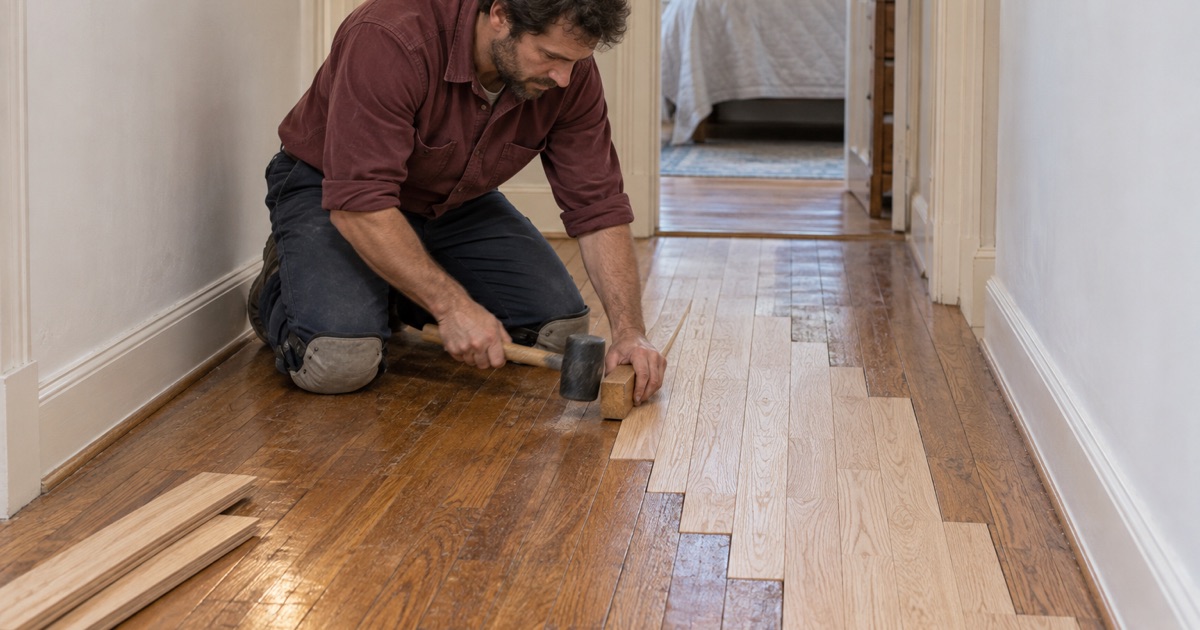
Tongue and groove boards lock into their neighbors, so removing one without damaging the next takes care. We cut the damaged board down its length, lift the pieces out, and clean the grooves of the boards around it. Replacement boards are then fitted with the bottom lip of the groove trimmed where needed, glued and fastened so they sit flush.
For larger areas we weave the repair in, removing boards in a staggered pattern so the end joints of new boards fall at different points. A straight-edged patch reads as a patch from across the room; a woven one follows the rhythm of the original layout.
Matching Species, Width and Cut
A repair board must match the species, the grade, the width and the cut of the original, whether plain-sawn, rift sawn or quartersawn, or it will show no matter how carefully it is finished. Older floors often use widths and thicknesses no longer common, so we source matching stock or, when needed, mill boards down to fit.
When nothing matching can be found, we sometimes take boards from inside a closet and use those in the visible repair, then fill the closet with new stock where it will not be noticed.
Pet Urine and Black Water Stains
Dark stains from pet urine, plant pots or leaking appliances form where moisture has reacted with the wood’s tannins, often deep into the board. We sand a test spot to see how far the discoloration goes before promising anything. Shallow marks sometimes sand out; black stains usually do not.
For deep stains, board replacement is the reliable fix. We replace the stained boards, check the subfloor beneath for lingering moisture or odor, and seal it if needed before the new boards go down.
Repairs Across Different Hardwood Floor Types
Nail-Down Floors Over a Raised Foundation
Solid hardwood nailed over a plywood subfloor or a board subfloor is the most straightforward to repair, because the framing can often be reached from the crawl space. That lets us fix squeaks, sister a cracked joist, or replace a section of subfloor without disturbing more of the finished floor than necessary.
We also check the cripple wall area and posts for settling while we are underneath. A floor repair above a sagging support will not stay flat for long, and it is far cheaper to find that during a repair than after a full refinish.
Glue-Down and Floating Engineered Floors
Glue-down engineered hardwood on a slab-on-grade is repaired by cutting out individual planks and bonding new ones with an adhesive suited to the slab’s moisture. Floating floors can often be disassembled back to the damaged plank from the nearest wall, then clicked back together with a replacement.
Because engineered planks come with a factory finish, we match the finish color, sheen and texture, including wire-brushed surfaces, rather than sanding the repair area. A thin wear layer does not leave room for aggressive blending.
Parquet, Herringbone and Patterned Floors
Patterned floors are repaired piece by piece. Loose parquet tiles are lifted, cleaned of old adhesive and reset, and damaged herringbone or chevron slats are replaced with pieces cut to the same angle and length so the pattern carries through without a break.
Older parquet may sit on black mastic, which can contain asbestos. We identify the adhesive before scraping or sanding it and follow the applicable rules, including SCAQMD Rule 1403 and its survey requirements where they apply to the building and the size of the area.
Finishing the Repair So It Blends
Spot Finishing or Refinishing the Room
A repair on a floor with a recent finish can often be sanded and finished in place, feathering the new finish into the old. On an older, worn or ambered floor, even a perfect board repair can stand out against the surrounding finish, and refinishing the room gives the only truly seamless result.
We show you the likely result of each option before starting, so you can choose between the lower cost of a spot finish and the uniform look of a full refinish.
Thresholds, Reducers and Trim
Repairs often extend to where the floor meets another surface. We replace damaged reducers, T-molding at doorways, stair nosing at the top of a staircase, and quarter round along the walls, matching species and finish to the floor.
We also check the expansion gap along walls during repairs. A floor that has buckled against a wall often needs that gap restored, or the same boards will lift again the next time humidity rises.
- 20+ Years on Wood Floors
- Itemized Written Quotes
- Lead-Safe Checks on Pre-1978 Homes