
Monterey Park Wood Flooring installs and refinishes hardwood stair treads in Monterey Park, CA, serving surrounding cities including South San Gabriel, East Los Angeles, Alhambra, Montebello and Rosemead, and brings more than 20 years of hardwood work to the most-used, most-scuffed part of any home. We refinish existing oak treads, install new solid treads and risers, and convert carpeted stairs to hardwood with retrofit treads matched to the floor at the landing.
Stairs are quoted by the tread, riser and nosing rather than folded into a square-foot floor price. Each step is its own piece of carpentry, with a nosing that must be shaped and returned, a riser that must meet the tread cleanly, and ends that have to be scribed to walls and stringers that are rarely perfectly square. A per-step quote shows you exactly what you are paying for and lets you compare it fairly against anyone else’s.
We also look at the staircase as part of the whole floor. The treads should read as one with the hardwood at the top and bottom, the finish should suit the traffic, and in an older home any painted parts should be handled with the lead-safe care the federal rule requires.
Stair Tread Options for Every Staircase
Refinishing Existing Oak Treads
Many staircases already have solid oak treads under carpet or under a worn finish. Where the treads are sound, refinishing is usually the most economical option. Each tread is sanded by hand and with small machines, because a floor sander cannot reach stairs, then stained and finished to match the adjoining floor.
Before we quote a refinish, we check each tread for cracks, deep staple and tack-strip holes, loose nosings and signs of sand-through from earlier work. Treads that are too damaged to refinish can be replaced individually, so one bad step does not force a new staircase.
New Solid Hardwood Treads and Risers
Where treads are damaged, too thin or made of construction lumber meant to sit under carpet, we install new solid hardwood treads and risers. We template each step, cut the tread to fit, and fasten and glue it so it stays tight and quiet under daily use.
New treads can be red oak, white oak, hickory or another species to match the floor. We usually recommend hardwood with a hardness suited to the traffic, since stairs take concentrated wear at the front edge of every step.
Retrofit Treads Over Existing Stairs
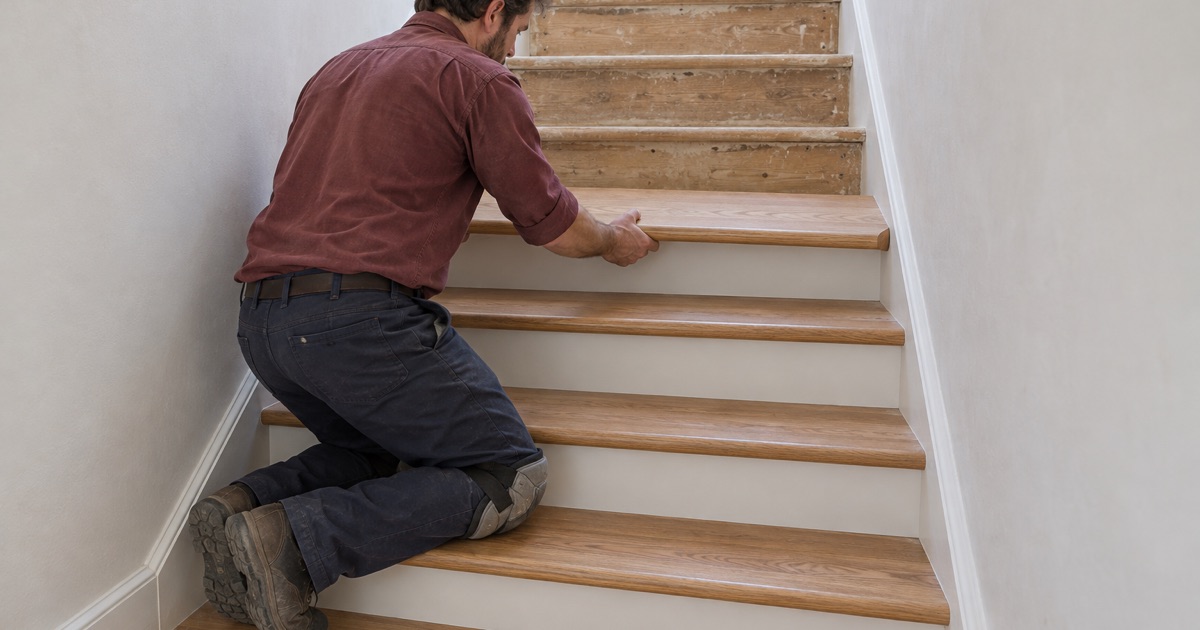
Retrofit treads are designed to cap existing stairs without tearing out the structure. After removing the carpet, pad and tack strips, we cut back the old nosing where needed and install a new tread and riser over each step, scribed to the walls on either side.
This approach is ideal when the existing stairs are structurally sound but were never meant to be exposed. It is also cleaner and quicker than rebuilding the staircase, and it keeps the stair rise and run consistent from bottom to top.
The Parts of a Hardwood Staircase
Stair Nosing and Returns
The stair nosing is the rounded front edge of each tread, and on an open staircase it wraps around the exposed side as a return. Nosings take the most wear on a stair and are the first place finish wears through. We shape and sand them carefully, and on retrofit work we make sure every nosing projects the same distance so the stairs look and feel uniform.
Where the staircase meets the upper floor, a landing tread or a flush stair nosing finishes the transition. We match its species, profile and finish to both the stairs and the floor so there is no visible break in the line.
Risers, Painted or Wood
Risers are the vertical faces between treads. They can be finished to match the treads for a continuous wood look, or painted, often white, for contrast and to hide scuffs from shoes. We prepare and install either option, and we caulk and paint risers cleanly against stained treads.
Older risers are often painted already, which is why we check the build year before sanding them. In pre-1978 housing, painted risers may contain lead, and the work follows the lead-safe practices described below.
Landings and Transitions
A landing is often a small section of floor between two flights, and it must match both the stairs and the main floor. We install landing treads, reducers and T-molding where the stairs meet other flooring, keeping each transition flush and secure.
We also check the stringers and any loose balusters while working on the steps. A creaking stair or a wobbly rail is easiest to fix while the treads are off or being refinished.
Matching Stairs to Your Floor
Species, Stain and Sample Treads
Stairs that do not match the adjoining floor stand out immediately. We match species first, then build sample treads or test stain on a sanded step so you can see the color in the stairwell’s own light before committing.
Where the floor is prefinished or engineered, matching the stain and sheen on site takes more testing, and we tell you honestly if a perfect match is not possible so you can choose a deliberate contrast instead.
Finish and Grip on Stairs
Stairs need a finish that resists scuffs at the nosing and is not slippery underfoot. We usually recommend a satin or matte sheen in a durable waterborne or oil-modified polyurethane, and for some households a finish with a slip-resistant additive or a textured wire-brushed surface.
Every finish is chosen from products legal to apply in the South Coast air district. We allow full recoat windows between coats, because stairs are hard to protect once the household starts using them again.
Stairs in Older Homes and Rentals
Lead-Safe Work on Pre-1978 Staircases
Older staircases often carry painted risers, stringers, railings and balusters, and in pre-1978 housing that paint may contain lead. The federal lead rules treat a staircase’s treads and risers together as one component when paint is evaluated, so we consider the whole staircase rather than step by step.
Where the EPA Renovation, Repair and Painting Rule applies, we contain the work area, minimize dust and follow the rule’s cleanup and verification steps. We confirm the build year before any quote so this is planned in from the start.
Rental and Multi-Unit Stairs
Interior stairs in townhomes and rentals take heavy wear from moving furniture and tenants coming and going. We refinish or replace treads during turnovers, often finishing alternate steps first so the stairs stay usable, and we itemize the invoice so a landlord can separate normal wear from damage.
Our Step-by-Step Hardwood Stair Tread Process
Step 1: Measure and Quote per Step
We measure every tread, riser and nosing, check the structure and the build year, and give you a per-step written quote. Options such as painted risers or a new landing tread are priced separately.
Step 2: Remove Carpet and Prepare
Carpet, pad, tack strips and staples are removed, loose treads are secured and squeaks are fixed. Where needed, old nosings are cut back for retrofit treads.
Step 3: Fit or Sand Each Step
New treads are templated and fitted one by one, or existing treads are sanded by hand and machine. Each step is checked for fit and flatness.
Step 4: Stain Samples and Finish
You approve a stain on a sanded step or sample tread. We then apply stain and finish coats, respecting the recoat window between each coat.
Step 5: Trim, Paint and Handover
Risers are painted or finished, returns and trim are completed, and we give you written dates for when the stairs can take normal traffic again. We walk every step with you before we leave, checking for squeaks, loose nosings and finish flaws.
- 20+ Years on Wood Floors
- Itemized Written Quotes
- Lead-Safe Checks on Pre-1978 Homes